
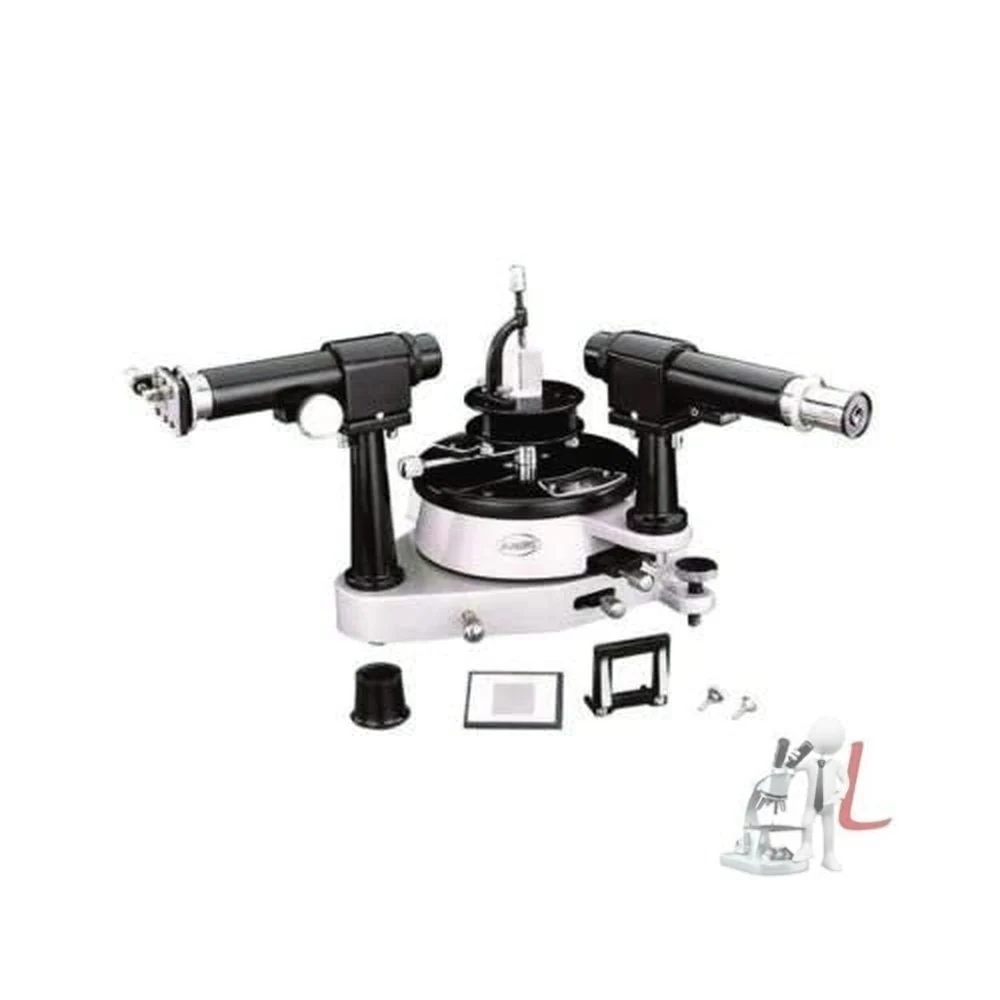
In India, a 6-inch (150mm) brass scale spectrometer is a standard laboratory instrument used in physics education and research for measuring optical properties like refractive indices and light wavelengths. These instruments are widely manufactured in scientific hubs like Ambala and Roorkee.
Key Features of 6-inch Brass Scale Spectrometers
- Base & Body: Features a heavy cast metal base (often 6 inches) with three leveling screws for stability.
- Optical Components: Includes a protected collimator and telescope with rack-and-pinion focusing and high-quality achromatic lenses.
- Telescope & Collimator: Rack-and-pinion motion for fine focusing.
- Base: Stable, heavy cast iron (C.I.) base with three leveling screws.
- Scale: 15.0 cm (6-inch) protected circular scale made of solid brass.
- Verniers: Two double-ended verniers with a resolution of 1 minute (or 30 seconds) of arc.
Key Specifications
- Scale Material & Size: Features a precision-engraved 6-inch (150mm) brass scale for accurate angular measurements.
- Vernier Resolution: Typically offers a resolution of 1 minute of an arc (1/60th of a degree), though some models can read down to 30 seconds.
- Dual Verniers: Usually equipped with two opposite vernier scales to eliminate eccentricity errors during rotation.
- Optics: Includes an achromatic telescope and collimator, often with a 10x Ramsden eyepiece and a cross-line graticule for precise targeting.
- Construction: Mounted on a heavy cast-iron base with leveling screws for stability during experiments.
Common Applications
- Prism Experiments: Measuring the angle of a prism and calculating its refractive index.
- Light Dispersion: Studying how light breaks into its component colors.
- Diffraction: Using diffraction gratings to determine light wavelengths.


Reviews
There are no reviews yet.