Key Features and Specifications
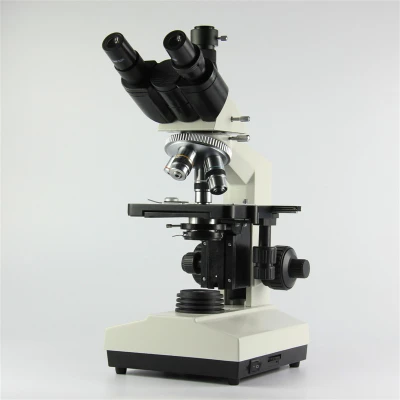
Based on the 107 series standards, these microscopes typically offer the following features:
-
- Inverted Design: The objective lenses are located beneath the stage, while the light source and condenser are above. This allows for the observation of samples in large culture vessels.
- Polarizing Capability: Includes a polarizer (positioned over the light source) and an analyzer (typically between the eyepieces and objectives) to detect birefringent materials like crystals or certain cellular structures.
- Optical System: Often features an Infinite Optical System or Achromatic optics to ensure clear, high-contrast imaging.
- Magnification Range: Standard configurations provide magnification from 40X to 400X (or up to 1000X with oil immersion), using 4X, 10X, 20X, and 40X long-working-distance objectives.
- Observation Head: Usually available with a Trinocular head (inclined at 30° or 45°) to allow for simultaneous viewing and digital camera attachment.
- Illumination: Typically uses a 3W LED or halogen lamp with adjustable brightness to suit different specimen requirements.
Typical Applications
This microscope is widely utilized across various professional fields including:
- Medical Research: Testing for crystals (e.g., gout) and analyzing cellular interactions.
- Life Sciences: Observing living cell cultures, plankton, and tissue development in real-time.
- Industrial/Environmental: Used in food inspection, environmental protection monitoring, and studying minerals or liquid crystals.


Reviews
There are no reviews yet.