
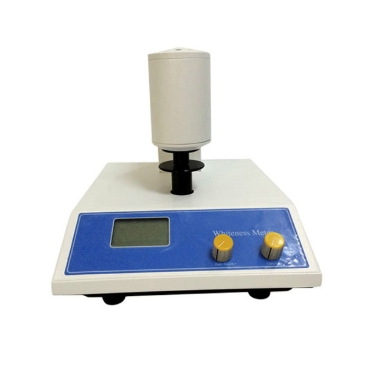
The Wincom Whiteness Meter is a precision optical instrument engineered to measure the whiteness value of various objects and materials. It operates by measuring the diffuse reflectance of light on the surface of a sample, providing accurate and standardized whiteness data. This instrument is essential for quality control, material grading, and color uniformity analysis in industries such as papermaking, textile printing, garment manufacturing, building materials, chemical powders, salt, starch, and plastics.
Technical Specifications
Measurement Range: 0 to 120 (Whiteness Value)
Light Source System: Long-life LED light source or halogen tungsten lamp setup
Measuring Geometry: D/65 diffuse illumination and 0-degree viewing conditions (or 45/0 geometry depending on the model)
Measurement Resolution: 0.1 or better
Zero Drift: Less than or equal to 0.1 per 10 minutes
Measurement Repeatability: Less than or equal to 0.2
Supported Sample Forms: Solid blocks, sheets, granular materials, and fine powders
Power Supply: AC 220V, 50Hz (or portable battery options for handheld models)
Key Features
Precision Optical Path: Built with high-performance optical sensors and an integrated sphere system that accurately captures light reflectance while filtering out surface gloss interference.
High-Contrast Digital Display: Features a clear digital LCD screen that displays whiteness values instantly, eliminating manual estimation or operator reading errors.
Multi-Formula Capability: Supports standard whiteness measurement scales, including Ganz Whiteness, Blue Light Whiteness (R457), and Hunter Whiteness formulas.
Powder Testing Attachment: Includes a specialized powder sample holder and compression tool, ensuring that granular or fine powder samples are flattened evenly for perfect optical readings.
Simple Calibration System: Designed with a quick one-key calibration routine using the included standard white board and black cavity to maintain long-term testing accuracy.
Primary Applications
Paper and Pulp Industry: Monitoring the whiteness of raw wood pulp, cultural papers, cardboard, and recycled paper sheets to maintain brightness grades.
Textiles and Laundry Labs: Testing the bleaching and whitening efficiency of textiles, fabrics, cotton yarns, and industrial laundry detergents.
Chemical Powders and Minerals: Determining the purity and quality profiles of talcum powder, kaolin clay, calcium carbonate, titanium dioxide, starch, flour, and industrial salt.
Plastics and Building Materials: Checking raw plastic pellets, ceramic tiles, paints, and gypsum boards for batch-to-batch color consistency.
Reviews
There are no reviews yet.