
Description
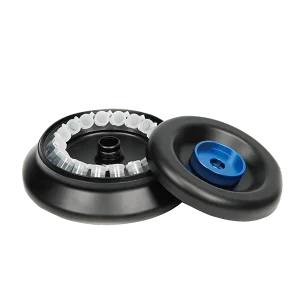
AS18-5 DLab is a right-angle centrifuge rotor for models D3024 and D1524R.
AS18-5 DLab rotor characteristics:
- Rotor type: angular, with cover.
- The bottom is round.
- Maximum speed: up to 15,000 rpm.
- Capacity: 5.0 ml×18.
- Maximum acceleration: 21,380×g.
- Rotor material: aluminum alloy.
- Compatibility: D3024 and D1524R
AS18-5 DLab is a practical and reliable accessory.
The rotor is the moving part of any laboratory centrifuge. Its rotation separates (separates) a liquid—an emulsion or suspension—into fractions with different specific gravities and particle sizes.
The extent to which the centrifuge rotor will meet the stated technical and operational characteristics depends on:
- reliability, safety and durability of equipment;
- accuracy of the set acceleration and braking modes;
- the magnitude of centrifugal acceleration;
- rotation speed stability;
- compliance of parameters with the requirements of the method;
- result of centrifugation.
General-purpose laboratory and academic centrifuges most commonly use two types of rotors: fixed-angle and swing-bucket. General-purpose and specialized laboratory centrifuges support specialized rotor designs, such as hematocrit, cytology, flow-through, microplate, and other rotors.
Design and operation features of angular and bucket rotors
An angle rotor (also known as a fixed-angle rotor or constant-tilt rotor ) has special slots into which the sample tube is placed at a specific angle. This angle remains constant during centrifugation and is typically between 20 and 40°.
To solve specific problems, rotor varieties are produced with a smaller or larger fixed angle of inclination of the sockets to the axis of rotation, up to 90° or 0°.
A swing-bucket rotor consists of a cross-shaped base with movable container cups or other holders attached to it. Some swing-bucket rotor models come with interchangeable holders. Test tubes, vials, and other containers containing test samples are placed vertically or at an angle within swing-bucket rotors.
During centrifugation, centrifugal force gradually forces the material containers into a horizontal position. Therefore, bucket rotors are also often referred to as horizontal, swinging, or tilting rotors.
The choice of the most suitable rotor is determined by the characteristics of the material being fractionated, the capabilities of the centrifuge and the tasks at hand.
Taking into account the operating features, the rotor of any type of centrifuge must:
- have sufficient strength at maximum acceleration;
- be chemically inert;
- do not cause vibration during operation.
To meet these requirements, modern laboratory centrifuge rotors are made of metal or synthetic materials with suitable properties.
Reviews
There are no reviews yet.